Showing posts with label Homeless. Show all posts

Sunday, November 15, 2020

We Never Know

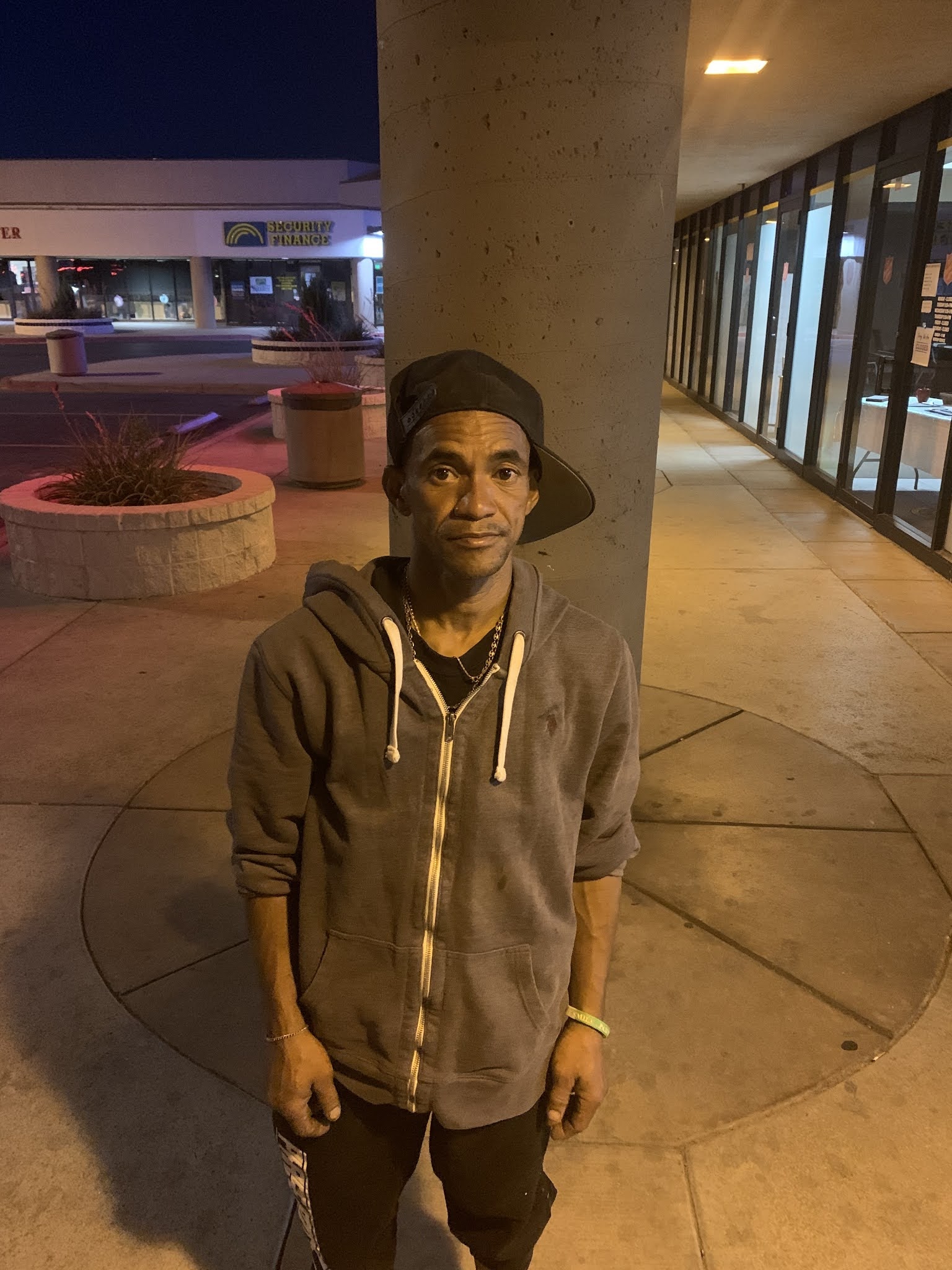
Roland at the bus station before we said goodbye

Six hours is way too long. I hate long drives, and even more than the drive, I hate making it longer by stopping.

“I need to go to the bathroom.”

“You can hold it.” I call back.

“I’m hungry.”

“There are plenty of old cheerios and fries jammed in those seats back there.”

“Is that the gas light?”

“No...maybe...we can make it.”

So it was a surprise when the sudden desire to pull over for the man who looked like a vagrant walking along the highway came over me. I guess I shouldn’t be too surprised; Anyone who reads my blog knows I don’t mind meeting new people under the strangest of circumstances, but the problem with people on the highway is a problem that fits best in a jr. high math class:

If a van is traveling the highway at 75 mph and passes a vagrant walking at 2 mph how long does the driver have to notice the vagrant and decide to pull over before he is so far down the road that the driver feels it’s too late?

That is exactly what has happened to me many times. I flinch and the slightest hesitancy at 75 mph makes it too late (probably not really but that is how I feel, which makes me hesitate again and then it's really too late; well, probably not really but that is how I feel, which makes me hesitate again and then it’s really really too late. Well, probably not really but that is how...you get the idea.)

And what causes us to flinch? Many things: We have all heard of stories of people getting picked up and then them finding bodies on the side of the road a short time later. In addition, at this time we were in the middle of the Coronavirus pandemic. Our leadership had instructed us to avoid one another; what better reason is there than that? And of course, number three, I don’t want to get involved (I wrote on this earlier.) And don’t get me wrong, your safety is a valid reason to debate, but I can attest that I felt a real clear impression to pick him up.

The difference this time was I didn’t hesitate. It likely helped that I had recently gone through a similar situation and Jeanine had been nothing but supportive (she really is amazing). I quickly followed the impression and pulled off the road only 100 or so feet in front of the traveler, which, if you are still following the math problem, means I have lightning fast reflexes.

A short, skinny man carrying a small plastic bag and a longboard got in the front seat. We were traveling, so our front seat was covered with snacks, garbage, diaper bag, etc. We pushed what we could to the side and tried to pass the longboard back so he could jam in.

“Thanks for picking me up. I can give you money for gas,” He offers as he gets situated.

“That’s okay. What’s your name?”

“Ronald.”

“Where you off to?”

“Las Vegas.” His voice was soft and had a sort of accent, and the two made him very hard to understand.

“We can take you to St. George, but you will have to get the rest of the way from there. Why are you going to Las Vegas?”

“I live there. Is it far?”

“Las Vegas?” He nods. “It’s still at least a three hour drive.”

He looks perplexed. “That’s far. But you can’t take me there?”

“No, we are only going to St. George.”

“Okay, I’ll walk from St. George.”

“That’s a long walk. I’m not sure you want to do that.”

He looks concerned, as if to say, ‘what other choice do I have?’ but just says “I mean I will get there tonight?”

“Not if you walk you won’t.”

We are rolling down the road by this point and we offer him something to eat and a water. He graciously takes both. Finishes the whole water quickly, we offer him another, he again finishes quickly, so we offer another, again with the same result. It’s clear he is very thirsty and has nothing to eat or drink in sometime. “How long have you been walking?”

“About 2 hours. You sure I couldn’t get a bike or something in St. George, so I could ride it to Vegas”

“That would still be a long ride. What are you doing in Utah?”

“They drove me up last night to help them move a big chair, but then I lost my friend at the gas station. Could you get me close to Vegas?”

“I’m sorry I need to stop in St. George. So, you like to longboard?”

“No. You can have that. I don’t know how to use it. I just found it on the side of the road.” He goes on to show me what was in the little bag he was carrying, other things he had found on the side of the road. An old political flyer, a paper license plate, a metal hunk of a broken car.

As we spoke a picture of what was going on began to become clear. This was not a homeless vagrant as we had guessed. While he was hard to understand, the more I learned the more I realized this was an adult, who was very much a child. He lived in a group home, didn’t know his phone number, could tell us the basic location but not the address. And no matter what I said I could tell that deep down all he could think about was how could he get home tonight.

It was like you losing your 8 year old at the gas station, them not knowing what to do and then they start walking home, when they are 300 miles away. Why didn’t people stop and help him, after all if you saw a young child in need walking along the highway wouldn’t you stop? But he didn’t ask, and he didn’t look like an 8 year old. He looked like a vagrant, someone who knew what they were doing walking down a highway, if such a thing exists.

We were lucky. The Salt Lake express was running from St. George to Las Vegas, we got him a ticket and made sure he got on the bus. The bus line was super helpful and let him stay with them until our amazingly generous friend, Jason Segedy, (who was willing to pick up a total stranger at midnight at the drop of a hat) picked him up and took him back to his group home.

I wonder what would have happened to our friend Ronald had we not picked him up. It was hot, very hot, he had no water, no food, night was coming. Even picking him up, it took us a lot of conversation, hard to understand conversation, to realize what he really needed and that giving him a ride part way and then dropping him off would likely just put him back into the same situation. I hope that if we had missed him that someone else would have picked him up. That they would have taken the time to figure out what was going on and what he really needed. But if you had been the car behind me would you have stopped?

Now I don’t doubt that if you would have known the situation, essentially a child, hundreds of miles from his home, lost and just hoping to get back, that you would have acted. But that’s it, we never know. We need to make split second decisions when traveling at the breakneck pace that society sets for us, whether to stop and put our own lives on hold to help others, or to stay in the fast lane. And if we don’t watch, listen, and be prepared to set aside our priorities we will leave Ronald and so many others like him lost on the side of the road.


Saturday, April 25, 2020

Thousands of Miles to Reach Thousands of Hearts

FB_IMG_1488579537335 - Copy
Compiled pictures of Justin Doering's Van taken throughout his trip across the country interviewing homeless. (Visit his website fiftysandwiches.com)


The world was watching as each state's polls were closing. Could Trump actually pull it off? One by one the votes were counted and then it was over, official, Donald Trump was the President of the United States. Many of us remember where we were that night. For some it was shocking, some exciting, and some debated their exit to Canada. But for others it was just another cold night on the street.

Justin Doering was driving slowly down the street that night as rain poured down in Cleveland Ohio. The van hadn’t exactly been the best or most reliable vehicle as it trudged along this cross country trip, but one can’t expect too much from a $1200 vehicle. One of its most problematic features was that it would have been easier to measure its gas consumption in feet per gallon rather than miles. But despite its downsides, it was his only mode of transportation, and more importantly, his home for the last few months.

How quickly things change. He pressed the brake to stop; he couldn’t have been going over 10 miles per hour, but a thin layer of water prevented it and the van gracefully slid and smashed into another van. A woman ran out of her vehicle yelling, looked at her car, and layed down on the ground, continuing to yell. Justin, with all his belongings in the van thrown askew, ran out with his sleeping bag and pillow, made the women as comfortable as possible and called the police. Then he looked back at his smashed van and wondered how he was possibly going to make the 2,000 miles back home. He also faced the question the people he interviewed faced everyday, where am I going to sleep?

“You have a van listed for $1400,” he said as he spoke to the man he had found online. “Well, I’m from Coeur D'alene, Idaho, and I'm in the middle of a project. I am traveling across America interviewing the homeless. The van I purchased for $1,200 to accomplish this got totaled last night. I could really use your van, but I can only pay you $700.” It was bold to only offer half the asking price, but desperation can bring out all sorts of things we didn’t know we had in us, and Justin’s financial situation was becoming increasingly desperate.

The plan had been simple: travel across America and trade sandwiches for interviews with the homeless. The plan was to highlight at least 50 of these interviews. He had harbored the idea in his mind since he was an early teen and even picked the name of the project back then: Fifty Sandwiches.  All through high school he spent time volunteering at a local shelter and getting to know individuals, completing his senior project on how the media’s portrayal of homlessness affects our view.

Justin attended college at Boise State, he worked hard and when it was clear that he was going to finish a year ahead of schedule he decided it was time to change the idea into reality. But, it wasn’t going to be cheap. He needed transportation, food, recording equipment, and a decent camera. One way to accomplish this was through kickstarter. The goal was to raise $10,000. The way kickstarter works is you have to raise your entire goal in your time limit or you get bupkis. He planned and prepared for 6 months for the kickstarter launch. The first few days were great and he had raised several thousand dollars. “I’ve got this in the bag,” he thought.

But as time went on the funding slowed. He was working a job as a sandwich delivery boy and then biking to campus for free wifi and staying until 11 at night trying to fundraise. For a while, it looked like it wasn’t going to come through, but a few days before the close he did it, he hit $10,000. He was going to do this.

After $1200 for a van and the cost of a decent camera to document the journey, it was clear that $10,000 was going to be tight to fund all his upfront expenses and 3 months on the road. He sold a computer and other electronics to try to get a few more dollars and then he was off. From Portland, OR down to San Diego, CA then to Tallahassee, FL to Boston, MA and back to the Pacific Northwest. He lived in his van, and while he would never compare what he went through to the lives of those he interviewed, he did experience some of the challenges of living on the streets. “For a time it felt as if Rangers and Police were my alarm clocks, regularly waking me up to see what I was doing. “But they were mostly supportive after I told them what I was up to.”

In Florida while interviewing Eva, a homeless woman struggling with mental illness, a scuffle broke out at the table next to them. It was a dispute over money related to a cocaine sale. One man pulled out a knife and lunged at the other's neck. Two other men grabbed the man and struggled to get the knife away as he held it inches from delivering a deadly slice. Just then a police officer pulled into the park and the fight quickly dispersed. Justin was shaken and fearful for his own safety, but to his amazement Eva didn’t flinch or think much of it. It was part of the life she lived.

From one interview to the next, he began to gain insight into the lives we rarely notice. And here he was on the phone hoping a kind stranger would take $700 for a $1400 van so he could finish his journey and get home. “The man was the kindest man I ever met,” Justin recalls. "He said he would take the $700." There was one problem. The man with the van was in Detroit, MI. And Justin was still in Cleveland, OH, with a van that was barely functional. It actually could run, but there was a shard of metal frame that jabbed into the tire if you made the slightest right turn. “I traveled from Cleveland, OH to Detroit, MI without a single right turn. I couldn’t even use the highway because taking an exit would be impossible. Just side roads and 3 lefts everytime I needed a right. There is no setting on Google maps for that.”

Once home, he worked to complete a book that would highlight his interviews. The effort was impressive, he had taught himself photography, graphic design, and ultimately publishing. The book is beautiful and inspiring. It shows, with realism and clarity the breadth of the problem of homelessness. He interviews the old, the young, the single mom, the grieving father, the mentally ill, the addicted, those who choose to be homeless and those who have overcome some of life's most difficult struggles. Throughout the interviews he includes well researched information about the current state of homelessness in our nation. He paints a vivid picture of what these lives are like, not shying away from any of it’s dark realities. He quotes, “It is not that the stereotypes are untrue, but that they are incomplete, they make one story the only story.”

Fifty Sandwiches work continues. The goal of the organization he started is simple, to close the gap between the perception of homelessness and reality. He does this one interview at a time, one book sold at a time. Justin today works a full time job and then spends his evening selling building the organization he hopes one day will be his life’s work.

I would encouraging everyone who reads this to buy the book. At about $20 bucks for a hardback filled with amazing photos and interviews, it is a great deal. The money goes to a great cause, to help Justing continue the work at fifty sandwiches. And on top of that it is an amazing book. You will enjoy every page and you will find that it enlightens your mind and softens your heart and anything that can do that is worth pursuing.

Two ways to buy the book Justin’s website, this is how I recommend you buy it. It’s a little cheaper and he will sign it for you.

Or if you prefer here is the Amazon website.

If you liked this article please consider subscribing to my blog by entering your email below.

Enter your email address:


Delivered by FeedBurner

Wednesday, March 11, 2020

Is America Great?

At Dinner with Alanna, Josh and Brandon

Life had never been easy for young Alanna, she never knew her Father, never even knew anything about him until she was an adult and then figured out very quickly she was glad that the violent alcoholic had not ever been in her life. Her Mother did her best that a single Mom could do trying to raise a family by herself. When little Alanna came home and said that her friend Brandon, who was only 5 years old, had been abandoned by his family, her Mother decided to adopt him and add one more mouth to feed. 

But despite loving her, her Mother was far from perfect, and when her older brother starting bringing drugs home, Mother, rather then stopping it, joined in. Due to the Meth addiction of her Mother young Alana found herself on the streets for the first time at age 16. Her Mother would go on and off drugs for the next few years. Brandon would join the Navy and spend two years on a submarine before being discharged and coming back to Indiana. 

Alanna went on to fall in love with a boy named Josh. Josh had special needs but kept a job at Indiana Beach being a stunt double for their shows. When Alanna was able to help her Mother sober up for the first time in a long time things looked like they were going pretty good. Her Mother was sober, she wasn't on the streets, Brandon was home and Josh's job brought in a few bucks so they had some money.

But things changed fast, her older Brother was still caught up in the drug scene and one night, a deal went the worst way a deal can go and Alanna's Mother was murdered by a local drug dealer. A short time later, Indiana Beach shut it's doors and the trio of Alanna, fiance Josh and adopted brother Brandon, banded together on the streets. 

The only shelter that they were near in Indiana was a Men's shelter, that meant that if the nights were freezing Alanna had no place to go. "No one will give you a job in Indiana if you are homeless." Alanna states as she recalls there time back home. "Police do nothing but harass you, and if it's freezing, well, too bad."

Josh's Father told them that he planned to move to a small town outside of Denver in May, and he was getting a large piece of property, and they were welcome to 2 acres if they wanted. It was more than anything they had in Indiana so they somehow got a vehicle they hoped would get them to Denver and hit the rode. They were wrong, the vehicle never made it, but with rides and help they did. 

Now they just have to wait until May, but things have been very different for them in Denver. "There is a clinic that sees us for free and helps get me my asthma medication. There is a local church that helps us with food. The police stop to make sure we are okay, and if it's below freezing they help us get to somewhere with shelter so we don't freeze. And best of all there is a daily work place that will help get us temporary work," Alanna says. 

Brandon pipes up. "I have had two places offer me a job once I get my ID which should come in the mail in a few days."

I, knowing that addresses can be hard for homeless ask, "Where are they sending your ID's?"

"A local charity gave me a box to use as an address."

"They are way more helpful here. When we told the guy that Josh had special needs, rather than look at us like, too bad, he said, 'no problem' and helped him fill out the application right then and there. It was totally different experience," Alanna adds.

This experience, oddly enough, reminded me of two statues.

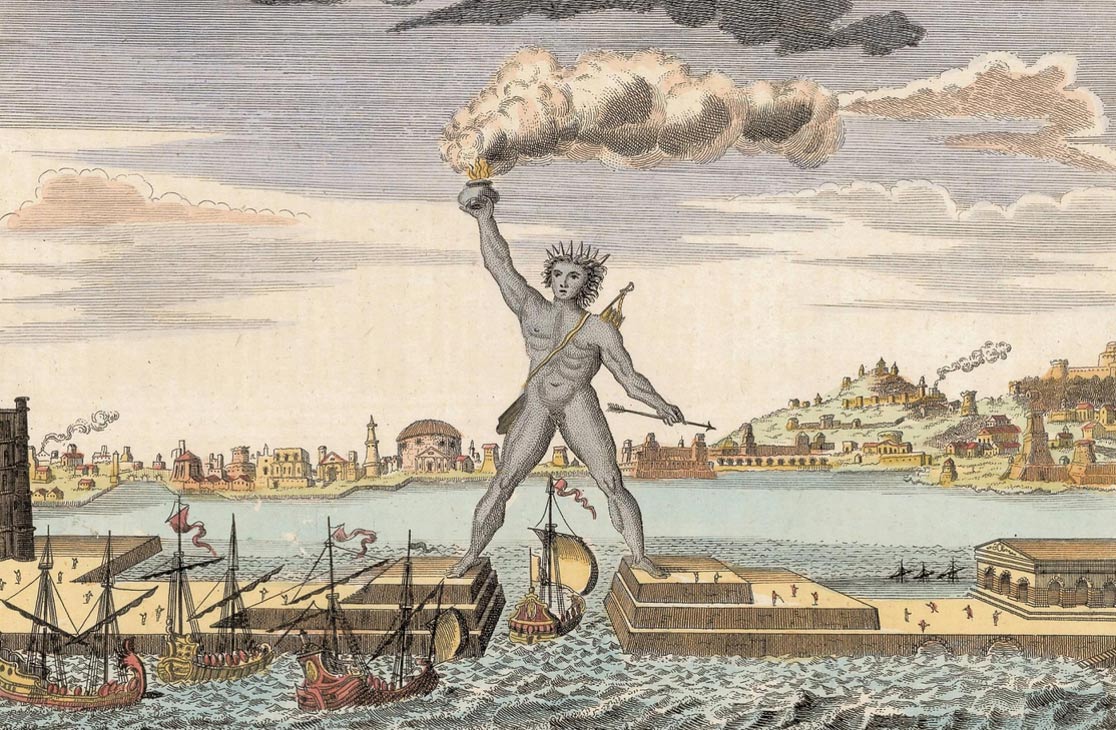
The Colossus at Rhodes was a statue of the Greek God Helios. At over 100 feet it was the largest statue of the Ancient world. It was erected to show Rhodes power after they had a victory over Cypress. 
The Colossus of Rhodes: Ancient Greek Mega Statue

In 1883 the United States was in the middle of a Depression. They too hoped to erect a large statue. They needed to raise funds to build a platform on which to place a statue of a beautiful women that had been given to them by the French in honor of their friendship. A young poet, Emma Lazarus wrote a sonnet that was to be auctioned off to raise funds for the pedestal.  

In the end, the statue was to be similar in size to the Colossus at Rhodes, and it would undoubtedly be compared to it. But would the comparison be fare. Lazarus knew that unlike the Colossus at Rhodes, which was erected to show power over others, this statue was a symbol of strength through friendship, love and charity.

To make this clear she penned the immortal words, a portion of which were placed and still sit at the base of that statue today:

Not like the brazen giant of Greek fame,
With conquering limbs astride from land to land;

Here at our sea-washed, sunset gates shall stand
A mighty woman with a torch, whose flame
Is the imprisoned lightning, and her name
Mother of Exiles. From her beacon-hand
Glows world-wide welcome; her mild eyes command
The air-bridged harbor that twin cities frame.
"Keep, ancient lands, your storied pomp!" cries she
With silent lips. "Give me your tired, your poor,
Your huddled masses yearning to breathe free,
The wretched refuse of your teeming shore.
Send these, the homeless, tempest-tost to me,
I lift my lamp beside the golden door!"

In a depression, when we were struggling to take care of ourselves she knew where Americas power truly would come from. Not from showing how great we are or only accepting the worlds best and brightest it would be from showing that we were open and prepared to receive the lowest of low. Those who needed help. She was not blind that they would come with baggage, struggles and needs. But She knew that we had something to offer, something that would make them and us better.

A portion of those words still sits at the base of the Statue she helped raise the funds to erect, the Statue of Liberty.

I do not know all the reasons it didn't work out in Indiana for this group who has had so much of worlds adversities laid at their feet. But when I hear about their experience in Denver, it reminds me that what makes our country great is not just men and women who have pulled themselves up from poverty, but men and women who have pulled, loved and helped others along as well.

If you enjoyed this please enjoy another one of my homeless articles: Getting Behind the Wheel


If you liked this article please consider subscribing to my blog by entering your email below.


Enter your email address:


Delivered by FeedBurner

Monday, February 10, 2020

Getting behind the wheel


Chris stood, slightly crouched and motionless waiting for the exact moment when the call would tell him to go from perfectly still into an instant sprint.

“Hike”

Chris took off horizontally across the field behind the line and running back, the quarterback faked a hand off as Chris pushed himself to move even faster than his legs had strength. Chris was the fastest player on the field but he would have to push even his limits for this play to work. At the exact moment he turned a perfect ninety degrees and started heading down the field. The safety caught Chris’s eye and began to close in, Chris juked to the outside and glanced up just in time to see a spiral passing over his head, he leaped grabbed the ball falling forward into the endzone.

The adrenaline rushed through his body as a whistle blew, “Good practice boys. Now hit the showers.” The couch called out as the safety reached down to help Chris up.

“I let you have that one.”

“Yeah right, keep practicing someday you will be able to keep up.” Chris joked back. Sweat dripped from every part of his body, he gave his all, even if it was only a practice. He knew he and the team would have to be better than ever if they were going to stand a chance against the Monarchs in the CIF championship next week.

Football had become Chris’s life. It was the first time that he felt accepted and part of something bigger. People looked up to him and cared about him. He felt more love and compassion from the men who spent their after school time slamming into him at full speed than he had his whole life off the field. His Father had left him at age 7 and his Mother, who only saw too much of his Dad in him often would beat him. Football was his ticket to leave that life behind. This Championship was the beginning of a new life for Chris, one he was convinced would culminate in his ultimate goal, playing on Sunday in the NFL.

Chris gathered his gear after showering and took what little strength he had left and began to walk home. Many of his friends were already driving, but given the make up classes he had to do and other issues at school he hadn’t taken drivers ed yet. He figured next year, his senior year, he could fit it in.

He turned the corner to see a Uhaul outside of his home. “Not again,” he thought.

“Mom, what’s going on?”

“Billy said we could move in with him in Alpine. Isn’t that great?”

“I am not moving in with your new motorbike boyfriend,” Chris yelled.

“Don’t talk back. It’s already been decided and you're coming.”

“Or what Mom?” The days of her being able to take her aggression out on him had passed, and both of them knew it. “Mom, the football championship game is a week away. I am not going to miss it.”

“I know you think that game is important, but this is a big chance for us. I will see if we can work out you coming back for the game.”

“We won’t be back and you know it.”

“Honey, get your stuff packed we’re leaving.”

“You might be, but I’m not,” Chris yelled as he took his pads and helmet and took off running down the street. He could hear his Mom trying to chase him and yell at him to stop, but he just kept on running. He couldn’t believe his Mom would move out right before his big game. He wasn’t sure where he would go, he just wandered the streets. Late that night he decided he better go home, what else could he do. When he arrived the home was deserted, they had left him.

Chris eventually connected with his Grandma. She didn’t live very close but it was close enough that he was able to get to the game. They lost 31-0. He spent the rest of the school year with his Grandma transferring to the school that had beaten him. By the summer things hadn’t worked out with the boyfriend so his mom came back. He had hoped to return to his old school but due to not registering timely and he now being 18, they said he would have to attend night school to complete his degree. That meant no football.

Without football to help motivate, he decided to simply get a job. The soup plantation had every soup and salad option you could think of and for the next six years he worked his way up from dishes, to line cook to cook. Meanwhile his little brother, Adrian continued with school close by. One day after work he went by his home to find his little brother Adrian had gotten a car, a rabbit. They went out together and Adrian asked Chris, “Do you want to learn how to drive?”

“I guess.” They went to a parking lot and Adrian tried to teach his older brother how to drive, but it was a stick and a tough one at that, and he gave up.

“Mom had to show me a bunch of times before I could do it. I’ll teach you later.” His little brother reassured him.

That later day never came but when Adrian graduated and needed a job, Chris his big brother helped land him a job at the Soup Plantation. Chris had been working there for years and couldn’t wait to finally get to move from the back of the house to the front of the house. But when the first opening came up, who got it? Adrian. Chris couldn’t believe they picked his little brother over him, and quite.

A short time later he was hanging out with his Brother-in-law's house. He was busy welding some stuff in the backyard. “What are you working on?” Chris asked.

“It’s a gate for a fence I have to put in tomorrow.”

“You build fences huh?”

“Yup, you want to learn how? I could use another hand on the job.”

“Sure.”

And like that they were a team, building fences all over the San Diego area. Chris loved the work and had so much fun doing it that he hardly felt like he was working at all.

“Chris you know we could get a lot more done if you could drive, to quote jobs, or cover jobs that I couldn’t be at,” His Brother-in-law mentioned one day.

“I guess, but I’ve never driven before.”

“I have that old van. You could buy it from me, like a rent-to-own thing. Just pay me a little each month until you pay it off.”

At over 30 years old Chris decided to do it. He took the van and learned to drive and went to the DMV and got his license. The first thing he needed to do with it was go out and bid a job. It was the day after he got his license and off he went.

The job was quite a drive away and as he drove onto the highway for the first time he nervously and slowly merged and horns blared in standard southern California style. A few miles later he nervously missed the exit, not once but three times, then when he finally found the exit, he got lost in the neighborhood. Three hours after his appointment, he finally pulled over, found a pay phone and called his Brother-in-law and boss. “Hey man, I can’t find this place.”

“Um Chris, I can’t talk right now, call me later.”

He tried several times but eventually went home. That night he finally got a hold of his boss. “What’s up Man?”

“That job, we lost it.”

“I’m sorry. I just couldn’t find it.”

“Chris, I don’t know how to tell you this, but I have to let you go.”

A little while later after not being able to pay for the car, Chris lost the van. Shortly after that he got a job at a moving company in Yuma. He worked for a year but when things slowed down at the moving company, not really being comfortable driving, he was the first to be let go. Shortly after that he became homeless. That was 18 years ago, and he has been in Yuma, mostly homeless ever since. “I love the winters here, but the summers aren't the best.” Chris says with a smile.

“My old boss saw me on the corner the other day. I asked him how business was, and he asked if I knew him. You fired me, I told him. Boy did he look shocked.”

Adrian, his younger brother now works for UPS. “He’s been driving for them for many years now. He does really well, but about 10 years ago he stopped taking my calls. I think he feels that he is too far above me to be bothered.”

Chris is a bright and positive person who anyone would feel good around. There were many things that came to mind when I sat and met with Chris but the most prominent for me is the license.

Licenses are an interesting thing. I didn’t get my license until I was 18, because I had to get my Eagle Scout to get it. But, I always knew I would get it. I took it for granted that I would at some point. I had parents who took me driving, not happily, but they did it. And it was such a part of growing up and the culture we live in I assumed everyone got their license.

But as I have met the homeless and worked with many who struggle with employment I am amazed how many do not have, and have never had licenses. This becomes a huge stumbling block for people. Think about how many jobs assume you have a driver's license? How often did your boss, even in early jobs ask you to run an errand? How many jobs involve some sort of delivery?

Not only that, think about how narrow your job search area becomes when you don’t have a car or driver’s license? In my town, it could easily turn a 15 minute commute into one of over an hour on the city bus. Not only that, think about how many times you rely on driver’s license as a form of ID? Where would you be without a drivers license?

It is so interesting to me the different paths of the two brothers, Chris and Adrian. One has been on the streets of Yuma for the past 18 years, one is a full time UPS driver, owns a home and lives a very normal life. One of the key differences in these brothers, was one got a license in high school and one waited until when he was over 30 and then never really got comfortable driving.

We all want to help homelessness, and we all know that an ounce of prevention is better than a pound of cure. But only recently has it occurred to me that one of the best things we can do for young men and women to keep them employed and off the streets is ensure they get a drivers license.

I have no doubt that if you are reading this, you probably have a license, and your kids will likely get theirs, but what about the kids around you. Do all your kids friends have a parent who can mentor them and teach them to drive? Do you know a kid who has dropped out before he got through drivers ed? Could you mentor them through the process to get a license? Do you know an adult without a license you could help get one?

One of the shocking stats to me is how many minority youth do not get drivers licenses. A study done in the University of Wisconsin found that in the state 75 percent of white’s had a license by age 18 (a number I found surprisingly low) but way more shocking was less that 35 percent of African Americans and Hispanics of same age had licenses.(1)

I hope this statistic is incorrect, but if it is even close to correct we need to help minorities get licenses. I am not sure how, but it starts with each of us, noticing those who need help, and expanding our circle to include those who need help.

I wonder if there is a kid tonight, wandering the streets, with shoulder pads and a helmet. A kid whose world is falling apart, who thinks his whole future is wrapped up in a football game, he is about to lose 31-0. Maybe I could pick him up, and just go for a drive, have a long talk and then pull into a parking lot and let him have a turn at the wheel.

If someone had done that for Chris, just maybe, he’d still be behind the wheel today.

If you enjoy this please read another one of my other Lessons of Homelessness. (When did you get out?)


If you liked this article please consider subscribing to my blog by entering your email below.

Enter your email address:


Delivered by FeedBurner

Reference

https://dc.uwm.edu/cgi/viewcontent.cgi?article=1067&context=eti_pubs, John Pawasarat, 2006, University of Wisconsin-Milwaukee, The Drivers License Status of Voting Age Population in Wisconsin.

Tuesday, June 25, 2019

What do you do with Crazy?

Steven's hat

“What can I do? This is the third promotion that I have been passed over for?”

“Steven, you are doing a good job. We appreciate what you do for us, you play an important role in coming up with drugs that save lives.”

“But am I stuck? Can I ever move forward?”

“The man who got the supervisor position has a PhD and is a well published doctor in chemistry. At the end of the day he was more qualified. We appreciate what you do but I have to go with the most qualified candidate.”

“I understand.”

Steven went back to his office logged off his computer, jumped into the car and headed to his condo, both of which he hoped he'd be able to make the payments on this next month. The sun had several hours earlier given up after a long day of unsuccessfully trying to win it’s battle with the snow and ice that perpetually clung to world, keeping it as cold as Steven felt inside.

That night, sitting alone Steven turned off the T.V. and pulled out his old bible.

“Good Master, what good thing shall I do, that I may have eternal life?

...if thou wilt enter into life, keep the commandments.

He saith unto him, Which?

Jesus said, Thou shalt do no murder, Thou shalt not commit adultery, thou shalt not steal, Thou shalt not bear false witness, Honor thy father and mother; and, Thou shalt love thy neighbor as thyself.

The young man saith unto him, All these things have I kept from my youth up: what lack I yet?

Jesus said unto him, If thou wilt be perfect, go and sell that thou hast, and give to the poor, and thou shalt have treasure in heaven: and come and follow me. But when the young man heard that saying, he went away sorrowful: for he had great possessions.”

Steven had been raised in a good Catholic home but with all the work and school had not had much time for church. Suddenly after reading about this young man he found himself asking, “God is that what you want me to do?” Steven prayed in his heart. “I’m not rich, but I guess. I’m doing okay. Am I just going round and round. Am I ever going to get any further? There will always be someone with another degree more than me, always someone ahead of me, perhaps it’s time to dedicate myself to God."

And that was it. He sold the condo and everything in it. Quit his job and drove the car to San Francisco, after all Chicago has tough weather to be going without purse or script. Once in San Francisco the car was sold and he took to the streets. At 30, he was wandering the streets, attending mass every day and spending up to 5 hours a day reading from a Catholic prayer book.

“I walked to San Diego and was there for a few years, when in 2009 I decided to do a walk across the country. I walked from Pacific Ocean to Myrtle Beach. It took me a little over a year. There were too many bugs over there, and prophets always seem to wind up in the dessert, so I walked back.”

San Diego was home base for a long time but eventually he got sick of landing in jail. “The police kept sending me to jail, the judge would always let me out. If you are good and don’t cause any trouble and just tell the truth the judge knows what is going on and will give you a ‘get out of jail free card.' But you get sick of it, so I finally decided to leave. I spent a few months in Brawley and then Blythe and now Yuma.

Why not become a priest? “To be a priest you have to fill out applications and get approved to a seminary and you can’t really do that while you are homeless. So, I promote, I am a promoter, promoting the religious life style. I’d say I am like the cover page on a website. I’m there to get clicks and get people on the site, if they want to find the subscribe or donate page they can find it, but I help them get there. You don’t need to be a priest of monk but everyone should have a religious lifestyle, so that is what I promote. If you are reading prayers the way you should, 1 hour morning, 20 min, midday, lunch and afternoon, 1 hour evening and some time for readings in between you won’t have time to do the sins that can get you in trouble.”

Steven explaining his daily prayer routine

“It’s almost six so I need to get to mass.” He starts to pack up and we walk the 15 minutes to St. Frances of Assisi Catholic Church. There I get to listen to mass the way people did for ages, in a language they didn’t understand. The mass was in Spanish and Steven who is not fluent in Spanish does know every prayer, and some are quite long.

Steven and I stand out like sore thumbs, (I don’t particularly notice sore thumbs but we did really stand out). For one thing we were both under 50. The only others being a group of three teenage boys who were dragged in by the ears a few minutes late. We were the only non-Hispanic people in the audience, we were the only ones with beards, but perhaps what made us stand out most of all was Steven’s hat. This hat is a sight to behold. “I got this straw hat in Ojai California, but in time it began to wear out were I grabbed it to take it on and off, so I reinforced it with some sticks I glued. I just kept gluing things on and over time, I now have this hat. The other thing that stands out on Steven is that he is scared, on his neck, ear, chest, arms and hands from a very bad burn that he says he doesn’t recall, because it happened at age 2.

People smile and nod as they walk by Steven and I. Steven participates in every way possible, singing loudly with the songs, in a falsetto higher than mine (and that is saying something). Reciting all the prayers, standing at all the right times, except for one thing. Steven doesn’t go up to get the sacrament. Why? I am not sure. I don’t understand all the rules with sacrament and the Catholic church but what is clear from the people around him is they are not comfortable around Steven. They are unsure why he is there, unsure if he is crazy, but they are sure he doesn’t fit in. I am fairly confident one of the reasons Steven does not partake of the sacrament is he doesn’t want others to feel uncomfortable.

We enter the church, attend the whole mass and then stay after for Steven to pray for a bit. We walk by dozens of people and no one, not one tried to talk to us. One could argue that they had a valid point, we didn’t speak Spanish, but I’m not sure how they would have known that. After all, he did recite every prayer and song in Spanish. And don’t take this the wrong way. This is not to attack the many people who attended mass that day. I don’t think they are hypocrites or bad people. My guess is that church was full of wonderful people who serve others and love others and do their best to follow Christ. My point is that we struggle to know what to do with people who are different than ourselves, different race, culture, religion and probably more than any of those, different levels of sanity.

I bring this up because I am right there with these people. True, I got to sit down and get to know Steven, but I have no clue how to help him. I am not a doctor, but I think he has a mental illness of some kind. Is it an anxiety about work and religion provides a convenient scapegoat? Does it have to do with the severe burns he received before he has memory of it? I have no idea.

But whatever it is, he is kind, happy, keeps himself cleaner than most people who live on the streets and really mostly keeps to himself. What would 'help' for Steven look like? An institution? Drugs? He doesn’t want those things. The easy answer might be to just leave him alone.

If your hoping for an answer on what should be done about the Steven’s of the world, and there are more than you think, don’t ask me. Because the answer to this one is: I really don’t know. But what I do know is, we will never find it by pretending he and the thousands like him don’t exist.

Wednesday, June 19, 2019

When did you get out?

Allen and I at Arby's
“We will go in and collect the weapons, you watch him. One false move and you know what to do. We’re counting on you Allen.”
The Commander took several of the men into the small house that had been used as a weapons stash, leaving Allen staring into the face of a young man, a boy really, he couldn’t have been more than 10 years old. Allen kept his machine gun pointed at the boy. He wasn’t much of a threat to the marines except in his ability to run off and warn others. They had no desire to take any prisoners, so the mission was simple, get the weapons out of this small home and once on the road allow the boy to run off. The plans changed with one small movement as the boy reached for his pocket.
“Keep your hands out of your pocket.” Hadn’t they searched him for weapons? But as his hand continued into the pocket Allen realized that the others hasty search could have missed a small detonator. Every-man on this mission except him was potentially about to be blown to bits and there only hope was for him to act quickly. Most shots would still allow for muscle movement and even a slight movement would allow for a detonator to be triggered, only one shot would guarantee the men's safety, Allen took it.
-------------------------
“I’m fine, let me go out.”
“I’m sorry Allen, you aren’t ready to go out on patrols yet.”
“It’s been three days. You expect me to just sit hear all day and go crazy.”
“I’m your commanding officer, you will go when I say you are ready.”
“Worried I’ll shoot up a village of innocent children.”
“Allen, that’s enough.” His voice was stern, but softened as he said, “Allen what you had to do would have shaken up any of us. And it was the right call even though it wasn’t a detonator, you didn’t know. But I need you to get it together, I will send you out as soon as I think it’s right.”
Allen walked off. His three closest friends died that day when there vehicle triggered an IED. “I am not proud of what I did. It haunts me to this day. And the fact that I did it ended up saving my life a few days later only makes it worse.”
He came back from the Gulf War and went back to doing exactly what he did before the war, construction. “My dad was a general contractor and I worked for him both in Washington before the war and in the Phoenix area after. We built custom homes. I can do everything on a home from the ground up. Framing, sheet rock, tile, stucco, plumbing. You name it.”
The company did well and even survived the great recession but what it couldn’t survive was the death of his Father. “He died seven years ago and my brothers didn’t want to keep the business going, so they sold all the equipment.”
Shortly after that Allen found himself on the streets for the first time. And once on the street he learned a hard truth. You are under a lot more scrutiny of the law once you are homeless. He had smoked marijuana for many years. “It keeps me calm when I have episodes about the war.” Smoking, buying and using pot had never really been an issue for him, but once on the streets he began to have run ins with police and they found the pot. Soon he was cycling in and out of jail. It was the same pattern, they would let him out, he’d search for work and every decent prospect would find out about his record and it would fall through, he’d sleep on the streets and at some point they’d catch him with pot again and he’d be back to jail. “They follow me around and tell stores that I am going to steal from them. I have never once stolen anything in this town, but the police feel the need to tell people I do. The only charge I have ever had is for marijuana.”
“I refuse to steal, can’t find work and have to eat, so I sit on the corner with my sign.”
This pattern allows him to survive, barely. “I usually get $15 to $20 a day. It’s enough for food and I save a little so that I can go to the truck stop and shower for $11, at least once a week.”
Today you can see him on the outskirts of town far enough out into the dessert that temperatures might actually drop below 100 degrees in the Yuma nights. “I stay further out because I don’t really get along with people. I refuse to stay in the shelter because I am prone to get violent in my sleep. I don’t want to wake from a dream only to find I have hurt someone.”
I realize as I speak with Allen that twice I end up asking him the same question. “When did you get out?” First as I learn about his military service and again when I learn that he has been in jail. Funny, that we move from town to town, or leave one job to another but when it comes to the military and jail, we “get out.”

Generally, we use the term ‘get out’ to describe a situation we didn’t want to be in. War and prison would likely both qualify. Both are experiences most of us wish to never have, both are very different than most of the lives we live. They are hard, they can leave us wounded and scared. Sometimes the scars are physical, sometimes mental and sometimes they are scars on our record. Funny things about scars, they make people different, and we don’t always accept people who are different. What I realized about Allen is that he may have gotten out, but I’m not sure we are ready to let him back in.

Monday, March 5, 2018

One arm? Homeless? No problem.


Between the San Diego airport and the bay is a thin strip of land that is filled with trees, grass, beach and rocks. It’s called Spanish Landing Park. It’s beautiful and many people walk along this preserved area. I walked down the park, the Sun had set but there was yet light enough to see, as I beheld a man running a piece of drift wood down the rough side of his skateboard.


“What are you doing?” I asked.

A common and truthful response to such a question may be, “none of your business.” But his first response was to look up and smile. What the smile lacked in teeth it made up for with contentment and acceptance.

“I’m remaking some tools. See I live on a sail boat and recently some of my tools for mending the sails and nets were stolen, so I am fashioning new ones. I made this earlier today.” He pulls out a much smaller piece of wood with a hole in one end. “That will act as my needle when I use a hemp thread to mend nets. This larger piece I’m workin’ on now is for the sails.”


Both pieces look very impressive but was is both most noticeable and adds to the richness of what he is doing is his obvious handicap. One is nothing but a stub and the other has a hand with a badly misshapen thumb and only three fingers.

“So, what is our name?” He asks.

“Nathaniel”

“Mine’s Will. Nathaniel is the mane of my oldest son.”

“How old is he?” I ask.

Let’s see he was born in 1986. So, he’s 31. I always remember the year he was born because that was the year I met my friend the Bull Shark. He was very friendly and wouldn’t accept the fact that I didn’t want to dance. In the end, he died but it cost me an arm, a few fingers, and a hole in my side.” He lifts up his shirt to reveal a large scar and missing section on his right side. I was living in Florida, working as a carpenter. It was shortly after I recovered that my son was born.” I was ready for him to tell me that, this was it, shortly after this horrible accident and having a young family he was driven to homelessness. But I was wrong and he continued, “And then in 87 my first daughter, and then my second daughter in 88. That was the year my wife was killed by a drunk driver.” Now, that had to be it. Three young kids, disability and his wife is killed, that was the trigger.

But I was wrong again. “I took the three young kids and moved to the middle of no where Kentucky, It as where my parents had retired and I needed their help with the small children. I worked at a Harley dealer and owned a tattoo parlor with several employees. We stayed there until all my kids graduated High School and were off to college. That was when I started trying new things.

“What do you mean new things? I asked.

“Well the first thing I did after they all graduated was give the tattoo parlor to my employees and took a job working at the salvation army. My kids thought I was crazy, they still do.”

It was clear he was very proud of his three kids that he had with his first wife, and very proud that each had attended college. As the story continued it came out that he actually had six kids. The last three he noted, “I loved so much he gave them each their own mother.” It is clear that he was much more involved in the lives of his first three. The youngest of which is now in the Navy and it was following her that brought him to San Diego. When he came he had no place to stay so spent the first few weeks on a park bench. Eventually with the money he had coming in from social security he had saved enough to purchase an old dilapidated boat and moved in.

Since then he has been living partially on boats, either his own or others he helps fix up or partially on park benches. He recently got back from Ventura California. He sailed solo on a 40-foot boat that he borrowed from a friend in England, it was part of a plan to save on dock fees.
Will was very colorful, full of energy, jokes and advice, “Why does the Easter Bunny hide eggs?” He asked. “Because he doesn’t want people to know his girlfriend is a chicken.”

Some of his advice included: “Is the glass half full or half empty? If you have a glass and something in it, you simply don’t know how lucky you are.”
“Don’t buy your own bull, and never ignore what your core or gut is telling you.”

Will was happy, hardworking, tenacious, not a victim and…homeless. Here is a man who had his arm ripped off by a bull shark and now is spending his time sailing solo from San Diego to Ventura.
Will in many ways remined me of Job, not so much for his hardship as because of his faith and hope.  Through loss of limb, wife and all else he kept his head up. Before I left him, he asked, “Do you believe in God?”

“I do.”

“I do too, but my one issue with most people’s view of God is that they think God is a man. I think God is a woman. No man could be as loving, nurturing and kind as God has been to me."


Tuesday, February 6, 2018

Getting out of...or back in "the system"?

Rob and Me at Jack in the Box

Being a single Mom is never easy. There is never enough money, time, or energy to get done what needs to get done. “My son would be better off without me,” often went through her head and when he turned 16 years old she left and he became officially part of “the system”. He did “okay” in the new life but his mothers ability to cope did not improve and by the time he was 17 she had not only left his life, but had taken her own.

By 18 he had graduated and the state funded group home he was a part of helped him land a job as a seasonal fire fighter. While he was working, they also helped him find a room in a shared apartment. At 18 with a job and a place to live, the State of Oregon was able to declare victory and clear the books of one more successful candidate who had left, “the system.”

A few months later the seasonal fire job ended, however he was undeterred and quickly found a job at Taco Bell. It was less pay but with the roommate sharing the bills, it was enough to get by. With work and a place to rest, he could sleep peacefully. That is until one morning at 2 A.M., when someone burst through his bedroom door yelling at the top of his lungs. Half asleep and sure someone was breaking in to attack him, he grabbed a small wood post that he kept near his bed, swung with all his might and heard a mighty crack that knocked the intruder both on his back and out. Fumbling in the dark, he turned on the light and saw his drunk, unconscious roommate lying on the floor in a pool of blood.

Rob grabbed some of his clothes as his roommate began to regain consciousness, within a few seconds Rob heard the return of the yelling, only louder and he was glad to be half way out the door before his roommate fully grasped what had occurred. The next morning, he returned to get the rest of his things. The bruised roommate apologized and asked Rob to stay. “I could have killed you.” Rob replied, “There is no way I am staying.”

A friend let him put his things in his garage, but after a few weeks of couch surfing, at the young age of 19 he spent the first nights of many on the streets. Taco Bell was enough to pay a portion of a room but not enough to get his own place, especially not when it required a deposit. A few weeks after being on the street he lost his job. “That first winter I would have froze, if it wasn’t for the truck stop. They’d let me stay inside. I get enough change for coffee and they would give me left overs and stuff. I had never tried coffee and by the end of the first winter I had lived off so much coffee that I vowed never to have it again. To this day the smell makes me sick.”

“I’d get a job for a while, get a place to live, loose the job, get a few months behind and by the time I found another job I would be back on the streets. That’s kind of the cycle I have lived for the last 22 years. Now at 41, I kind of found it easier just to embrace it.”

Running down the list of jobs he mentions a lot one might expect, waiter, construction worker, harvester, but building computers stands out.

“Yea, I built PC’s in Washington for a while. That’s what got me into gaming.” He gets very animated as he shows me his favorite game he plays on his phone. He is clearly very into it and by the sound of it plays most of the day. It’s a war, medieval, build castles, grow wheat, raid the neighboring village type game. He speaks of his guild mates, those he plays online with, as his family. “They are great, I look out for them, and they do the same for me. I have time to build up gold and food and I often give it out. They are very appreciative.” The symbolism of this last point is hard to miss.

“How do you afford the cell phone?” I ask. Oh, I have WIFI and power at 3 or 4 locations in town. I can always hang out at the library or here outside.” He was sitting with his cell phone plugged into an outside wall socket at Jack in the Box, when I first met him.

“How do you get by?”

“I get food stamps that I reapply for every 3 months. If I get sick the ER will see me.”

I am not sure now to ask the next question but fell compelled. “Do you have a plan to get off the streets or have you accepted it just part of your life?”

“I have narcolepsy, but since I’ve never injured myself it’s considered stage I. At some point I’ll fall asleep, hit my head, go to the ER, and get declared to be in Stage II, then I can get social security and finally have a steady paycheck and get off the streets.”

I was struck by the fact that, “the system” took a child abandoned at 16 who’s mother killed herself a year later, helped him get a job and room at 18 and then took him off the books, declared him prepared to live on his own. Now 23 years later the only path he sees to get off the streets is to once again through “the system”.

No one wants people to have to be on lifelong welfare. Everyone hopes people can get out of “the system,” and be on their own. But perhaps Oregon’s victory was premature? If you had Robs background would you have been ready to be on your own? Was a seasonal job and a roommate a recipe for success? Do our welfare programs at times simply shift the problem? Or hope to simply check a box next to someone’s name so they can be called rehabilitated?

Do we personally at times do the same to those who have been placed in our life, who truly need us the most?


Thursday, November 9, 2017

Paralegal to Prostitute

Jennifer and Myself in Denver


Jennifer was only 12 years old when she first found herself living on the streets. Mom demanded she attend school and she just wanted to goof off. "Most nights, I would find someone’s couch to crash on," she remembers. By 13, she was into drugs and in and out of juvenile detention. At 19, she was pregnant, and she gave birth prematurely to a boy who came out heavily addicted to alcohol and drugs. Not surprisingly, the state took the child. But finding foster care for such a high needs infant can be difficult (see my post on Doug Broadbent).

The state was lucky. A nurse with all the right background and knowledge had recently decided to foster. This would be her first and last foster child because after 6 months they were sick of being foster parents and simply wanted to be parents. The couple approached Jennifer and asked that she give up any rights to the child to allow them to adopt. While it was hard, she agreed, "They were going to give him a much better chance at life than I was prepared to give."

Since the birth, her personal life had not improved. Drugs still ruled her every action, and shortly after the adoption was finalized she again found herself in jail. However jail proved exactly what she needed. She went straight from jail to a rehabilitation facility. She was released at age 22 and that is when she began to get her life back. After acquiring her GED, she entered school at University of Colorado Denver to work on a Political Science degree. She married, got a job as a waitress, and most importantly, stayed sober. As she neared graduation she began to feel maybe Political Science was a mistake and took side classes to get a certificate as a paralegal. As she neared graduation she began an internship in her new field.

Then it happened. It had been 7 years of sobriety, but avoiding drugs doesn't guarantee an easy life. Her marriage was hurting and it ended in an ugly divorce. "After the divorce, I felt like a failure and just lost all my motivation." She lost her internship, dropped out of school and returned to drugs, streets and crime. That was five years ago.

I saw her near a Wal-Mart holding a sign that said, “Trying to pick myself up by going lower." When asked to explain, she said that she was trying to get a job as a sign flipper which many considered low, but any job would be higher for her. She said she was guilty of anything to get the drugs, but had finally decided that stealing and prostitution weren't worth it and that she had stopped those. She recounted how even begging was a step up from those.

As I thought of the lessons I learned from Jennifer, I thought of Oswaldo, another person dragged into a life of addiction at a young age. I also thought of how hard it would be to give up your only son. Even though the state had taken the child, if she hadn’t given up rights, he could be bouncing around in our legal system from foster home to foster home to this day. She did exactly what someone who loves their child should do, give him the best chance for happiness in a home with a loving father and mother. She said it better than I could: "I am proud of myself for giving him up, no matter how hard it was, and I'm grateful for the great parents who are raising him."

But the other thing I can't get out of my mind is the night 5 years ago when she felt so empty. When the failure of her marriage made her feel a failure at life to the point that she was ready to reenter the hell of addiction she had left seven years before. Why couldn't someone have been there to take her to dinner that night? To help her see how far she had come and how much she had to keep fighting for? If she had not slipped back into the darkness of her past that night, where might she be today?

Who around us is struggling today? Who is about to fall? Those in the depths of despair won't usually call out for help. Rather, we need to be in touch with their needs and call them up, seek them out, and rescue them before they surrender to whatever hell is closing in.

I wasn't there for Jennifer that day, but who can I be there for today?


If you liked this check out my last Homeless post: Devastating Debt

Wednesday, September 27, 2017

Devastating debt

Tom and Keith-Tom is the older gentleman

Deciding on dinner when I’m out of town and alone can be tough. I get tired of fast food, and sitting alone in a sit-down restaurant is not my style. Once, while in Denver with my family, we all went to Casa Bonita, a restaurant full of interesting scenery and a big waterfall that performers dive into while patrons eat. I drove over to the restaurant, thinking I might go again, but I couldn’t bring myself to walk in alone. I begin walking down the street.

Colfax Street was likely at one time a nice road, but now it’s rundown and flanked with smoke shops, pawnshops, and tattoo and massage parlors. A few blocks down, Walmart has built up a very nice shopping center with a dry riverbed and bridge, set back a little from the road.
This is clearly a popular place for the homeless to gather. I approach two men and start a conversation. Keith came from Pennsylvania (an interview from earlier)

Tom is older and has been in Denver since 1985. He grew up in Helena, Montana, the youngest of 8 kids. He has lost track of all of his siblings. He heard that one of his brothers, who had been a Catholic Priest in San Francisco, had died of AIDS, but he didn’t find out about it until several years later.

In 1978, Tom graduated from high school and worked in Helena for 7 years. Then in 1985, he decided to come out to Denver for an ACDC concert. He never went back. “I loved the weather, the mountains, and the atmosphere, so I decided to stay. Shortly after that, I fell in love, got married, and had a daughter.”

“What did you do for a living?”

“Heating and cooling mechanic. I even went to school at Metro Tech for drafting, but that didn’t work out.”

“You ever see your kid?”

“I haven’t seen my daughter in 5 years. She’s 30 now and lives in Denver, or at least she did last time I saw her. See, when she was 8, I came home from work one day, and everything was gone—my wife, my daughter, and the furniture. I took 3 weeks off work to look for them. Turns out she had run off with her ex-husband. She took my daughter, and her stepdad raised her as her father. She even took his name.”

Tom is surprisingly void of emotion as he tells this tragic story. He shows no bitterness towards his ex-wife or this man who replaced him in his family. It is not clear if time has healed his wounds or if he really feels this was best situation for his daughter anyway.

I’d seen such family breakups be the catalyst for homelessness, so I ask, “Is that when you became homeless?”

“No, I went back to work and did okay for another 10 years or so. Shortly after my wife left, in 1991, I bought a home. It was a nice 3-bed, 2-bath home, and the payment was only $450. But I took out several home equity loans, and my payment became over $900, so I sold it so it wouldn’t get foreclosed on. That is when I found myself on the streets.”

We talked for over an hour as we ate a sandwich from Jimmy John’s. Keith and Tom told me how they avoided downtown because of crime, how they remove “no smoking” signs at bus stops, and how it’s only safe to gather in groups of less than 4 and not on the Wal-Mart side of the channel.
Homelessness is almost never to be blamed on a single cause it’s usually multi-faceted a broken home, addiction, mental illness, adventure, etc. But sometimes you can see a primary cause, and for Tom, it was debt. As Tom spoke, I could see and how crushing debt can be, and I felt deeply grateful for my parents and church leaders who regularly spoke out about the negative impact of debt.

His story also led me to ask myself, Do we make getting debt too easy? Do we do enough to discourage debt? Would the financial advisers call the loans Tom had taken out and that eventually put him on the streets, ‘good debt’?

As noted above, choosing where to eat when out of town can be difficult. If I had chosen to eat alone, I could have had a much nicer meal for what I spent that night, but I am certain it wouldn’t have been nearly as enjoyable or satisfying.

Thursday, August 31, 2017

Drugs...It's always the drugs.


One of my favorite TV shows of all time is Monk. If you have not taken the time to watch every episode, I highly recommend you quit your job and stay home and watch them tomorrow. "You'll thank me later."

There is one episode, pictured above, where Monk goes to Mexico. The two detectives, when asked what led to the murder, answer, "Drugs...it was drugs...it's always the drugs."

"But the man drowned while sky diving," Monk puzzles.

"Trust me, Monk. It's the drugs."

Before I started interviewing homeless. I had the idea, and still feel many around me have the idea, that in many ways, that is the usually the answer for homelessness. "Why are they homeless?"

"It's the drugs."

Once I started interviewing people, I was surprised how often it was not drugs. Was drugs a significant issue? Yes. Was it the key issue for some. Yes (see story of Oswaldo). But the drugs we usually see as the problem...heroin, meth, cocaine etc... have rarely been the main issue with those I have spoken with.

Yet...it's still the drugs.

What do I mean? It really hit home when I met with Keith.

Keith and Tom in Denver

Keith came to Denver 8 years ago from Pennsylvania. (He has the red shirt). I met Keith and Tom sitting outside a Walmart in Lakewood, Colorado. (Tom's story here) We talked for a while and then Keith and I walked over to a local sub shop and got some food. His story was nothing out of the ordinary. He had worked some in construction in Pennsylvania but was between jobs when he met a girl online and rushed out to Denver to live with her. It lasted two weeks, and after that, he found himself on the streets. Eight years later, he is still there.

But what struck me most about Keith was the topic of conversation. When I approached, he asked, "got any cigs?" I, not surprisingly, did not.

As we walked towards the sandwich shop, he asked, "see any cigs?" hoping that I would notice any half smoked cigarette butts on the ground. Once we were walking out of the sandwich shop he said, "you know cigarettes are so much more expensive here then they are in Pennsylvania." We walked by someone else and he asked them, "you have a cig?" they did not. Then as we walked, he said, "do you have any money for me to get a cig?" A minute or two later, "I sure could use a cig." And then shortly after looking around he said, "It sure is hard to get a cig."

I would love to tell you this conversation was unique to Keith but it is very common among the homeless I speak with. Keith is not a druggy by most definitions. He is not hooked on meth or some other illegal drug. Yet almost 100% of his mental energy goes to an unfulfilled addiction.

I learned how he gets by, by living on the streets and food stamps. Meaning he gets very little actual income. The only cash he sees is from the very occasional odd job and from pan handling. This means that it is entirely possible that 100% of any money he sees, goes to cigarettes. I asked him if he ever looks for work. He looked at me as if the idea hadn't crossed his mind. I firmly believe that he is so in the thralls of this addiction that he rarely thinks about much else.

I felt awful for Keith. I feel awful for anyone trapped in addiction. I don't mean to diminish the negative impact from heroine, meth, cocaine, marijuana and prescription drugs, but I think if we were going to really peel back the true cost to society we would find that these hard drugs negative impacts pail in comparison to that of alcohol and tobacco. I think that you would find that while very few would say they became homeless because of alcohol or tobacco, it is almost universally part of the story.

If you follow this blog at all you will not be surprised to find that I hate homelessness but love the homeless. I do not have very many answers, but no answer that fails to recognize the debilitating nature of even what we see as "socially acceptable" and legal addictions will have the deep impacts that are needed.

Friday, July 21, 2017

This is great...reminds me of jail.


I approach the front desk at the hotel and ask, "So where do the homeless hang out in town?"

After an odd stare, he said, "Try the 99 cent store." This was the first time I had gotten this advice and it would prove valuable on several occasions, (Here is a story of someone else I met at a 99 cent store) not just in Redding California.

Upon arriving at the 99 Cent store, I did not see any homeless but did see two security guards. I approached them and asked, "Don't homeless people tend to hang out here?"
"Not any more." They laughed, clearly proud of having done their job.

"Do you know where they do?"

"Try down by the safeway...and tell them the 99 cent store guards say hi." They laugh again but then add, "Just kidding, don't tell them that."

On my way to the safe way I see what appears to be a homeless man with a small dog. I walk fast to catch up. "Do you know where the safeway is?" I ask. I really wanted to ask, ,"Are you homeless?" but it's a bit of an odd question, so I stick to directions to the store.

"Yea, right there." He points across the street, and we both begin to cross. I introduce myself and learn his name is Carlos Perez.

"Where you from?"

"Florida."

"What are you doing in California?'

"Just trying to find work."

At this point I am very confident he is homeless and decide I'll take him to dinner and find out more then. "You hungry?"

"Yeah."

"You want to get something to eat?"

"Yeah," he says with a smile.

"You have time to sit down?"

"I got nothing but time."

He is drinking what appears to be beer from a Nalgene bottle as we walk.

"So you're looking for work?"

"Yea, I had a job, but I blew that because I didn't have a phone to call in when I didn't show up. I did work on a farm up the highway a ways, but they pay me in weed."

He says it so casually that I assume I misheard him. "Did you say weed?"

"Yeah, weed and wax."

"What's wax?"

"Its made from the oil of the stock. See weed is like 24% TCH and wax is like 84%. It gets you high way faster. But it's too common in California, so it is not worth anything, but if I could send it to Florida it would be worth tons of money. Then I could go home with some real money."

It amazed me how casually he would discuss multi state drug trafficking with a total stranger. But not having much use for the ins and outs of weed dealing I moved on to another topic.

"Why'd you leave Florida?"

"Me and my girl wanted to travel. I'm a traveler, not a hobo who stays in one place. But my girl and I got in a fight and she left last night."

"Where do you stay?"

"We are lucky, we have a car. I'm not licensed or registered or anything but we get around. It is an old truck with no windows and shakes violently when you go over 25, but that is usually where we sleep. But I can sleep anywhere, after all it's just sleep. You do need to know where it's okay to go. Wal-Mart is the best. I've never been kicked out of a Wal-Mart. They let you sleep around the fence or in the lot."

"What about when it gets cold? Do you go to a shelter?"

"No way, I hate shelters. I just bundle up with lots of clothes or put my dog on my chest. If I need gas to run the heat I just sit on the corner with a gas can and people will get me some."

"So how long have you been in Redding?"

"Too long. I hate it here. Everyone is on drugs. This is the meth capitol of the world. That's part of why me and my girl fought, she has been clean for a year but has slipped back 3 times and it's hard here. I've never done that stuff. I don't want any part of it. It's just too addictive. Alcohol is bad enough. " He says, gesturing to his Nalgene.

We enter the Black Bear Diner and stand by the, "Wait to be Seated" sign. We are standing there for several minutes while we continue to talk. Several waitresses walk by. Finally after uncomfortably long I stop one and say, "Table for two." Carlos has his small dog with him. The dog has a vest that has a patch sewn into it that says, "Service animal." The waitress does not ask about the dog, but does lead us to a side room that has a few guests finishing their meal and puts us in the far corner.  It appears that this is the portion of the restaurant that they close earlier than the rest but decided it would be a good place to put us.

"So did you grow up in Florida?"

"I grew up all over. My Dad left when I was 5 and my Mom kept going back and forth between Puerto Rico, Massachusetts and Florida."

"How long have you been on the road?"

"For 4 to 5 years now. I love being a traveler, it is so eye opening not being a slave to work. I'm not lazy, and I like to work, but the rules don't apply to me." He stops, gets very serious and point to himself says, "For me, this is a choice. Some people are out here because they lost their parents or were abused and run away, but not me. For me, it's a choice. My family are still back in Florida, my Mom and my boy."

"You have a son?"

"Yeah, he is 16 years old, lives with my ex. I love my ex, we had our differences but we get along and she lives by my Mom and brother, all in Daytona. I also have a 22 year old daughter but I don't know where she is. She is a rebel like her Mom. I hate that woman. I was 15, had sex for the first time and found out she was pregnant. I stayed with her for 5 years, but she went crazy and disappeared."

I couldn't help but see my own 5 year old little girl and couldn't stomach the thought of never seeing her again.

"So do you see your boy?"

"Oh yea, he lives down the street from me." He speaks of his Mother's home as if it is his own, and even though he hasn't been there in 5 years, considers it so. (I wrote about his idea in How Many Ways is He Homeless?)

"Yeah, I was a Mason in Massachusetts making like $1,200 a week but I needed to be close to my boy so I moved to Florida and was only making $290 a week as a cook. But it was worth it to be by my boy."

It get's silent and I don't want to ask follow up questions because they will all lead to the obvious question of, "why did you leave then?" So I change the subject.

"What's your dogs name?"

"Her name is Black Dog."

Black Dog has been quietly, obediently sitting this entire time.  I realize I have been now waiting longer then I have ever waited at a restaurant. We are now the only ones in this room and I finally get up, find the lady who sat us and tell her we are ready to order.  She apologizes profusely and says she will  quickly send someone.

Shortly after I get back, someone comes to take our order. Carlos gets a Reuben.

"So why California, I ask?"

"I started traveling a little bit at a time. Each time I would get a little further from Florida. Then one day I met My Girl at a rainbow gathering and we decided to try California.  See, at the time, I had this really cool RV. It was the total party bus. I liked to paint and do like body art and tag. So my bus was tagged inside and out. We finally made it to California and a guy come up to us with a garbage bag and I say, 'What's in the bag?' He throws it down and it's full of weed--10 lbs. of it. And he gives me a little handful. I was like, 'I don't have the money to pay for this.' He said, 'No need, welcome to California!' So we decided to stay in California."

"What's a Rainbow Gathering?" I ask, again trying to get off the weed topic.

"They are where woods people gather and have festival. It comes from the ancient nature prophecy that said when the world is falling apart that it will be saved by the rainbow children who will bring back unity. There is some really good rainbow groups on Facebook and stuff. I can show you how to get involved. They are really good people."

Again I realize it has been really long, and I have to get up again and find the waiter. He again apologizes, and shortly after, our food shows up.

Carlos looks down at his Reuben and with a huge smile says, "This is great! It reminds me of jail."

"The sandwich?"

"Yeah, there was this jail in Keystone Colorado. It had the best food! I loved it there. I wanted to stay but got out. Actually I was surprised they caught me. I had just tagged this police car with a Sharpie, and some officers came up and said they knew it was me. I totally denied it, but then they asked to see my pockets and found my Sharpie markers. I should have thrown them in the dumpster. The jail was awesome, but the officer was such a jerk that I told him I would never come back to his town."

The irony of this statement was thick.

"Are most jails okay?"

"No, just that one. The one I spent a few weeks in Florida for having some weed was the worst. They gave you like one hard boiled egg, and that was your lunch. The conditions there were awful."

We get back to talking about the Rainbow People and he notes, "If you go on Facebook and type 'Rainbow Family' and request friends they will let you know when the next gathering is. I always tell people a gathering is like the Robin Hood movie with Kevin Costner when they go into the woods. I told you  about the prophecy and it totally makes sense, who knows how to get by without electricity? The rainbow people.

"Do you have Facebook?" He asks.

"Yeah, I just got it. I had avoided it for a long time." I admit.

"That's good. Most divorces today are because of Facebook. That is part of why my girl and I fought. I saw her phone and read some of her Facebook messages to other guys. She got all mad saying she is allowed to have friends. I was like, 'friends don't say that to each other.'"

By this time I had long since finished. Carlos had only finished half his sandwich but it was clear that was all he was going to eat. I again went into the restaurant to find someone to get us a check. Again, a profuse apology.

After we had paid, we walked out and Carlos asked if I wanted to hang out. I told him I had better get to bed, but at the stop light before I crossed he told me one more story. I wrote about it earlier and you can read it here. Anyone can see Carlos's life was full of contradictions. His decisions to travel versus his desire to be by his son. His disdain for drugs, and his love of Marijuana. His divorce vs. his love of his ex wife. His love of Keystone jail and his determination to never return. We all have contradictions in our lives and Carlos's contradictions made the Serpentine Stone story all that much more poignant. If you have not, I hope you read it.

But I cannot leave the story of Carlos and not address the mistreatment at the restaurant.  I do not think the restaurant purposely mistreated us. My guess is the lady put us in the corner of our own room because of our smell. Carlos's smelled about how one would expect a guy who had been sleeping in an old truck for weeks without a bath to smell. And Black Dog probably wasn't helping the smell much either. Given this, maybe the back room wasn't a bad place. After that, the total neglect, I think, was because they were busy and forgot about us. It was a room they didn't usually use that late, so to get to us was out of the routine. But purposeful or not, it was neglect.

I think most of our neglect of the homeless falls into this category. We don't mean to hurt, ignore or put them down, but to help them is out of our routine. Especially to really help them. So they get put in the back room, the homeless shelter, the bad part of town, and we get busy and forget about them. If we want to really help the homeless we have to get out of our routine, we have to step out of the day to day busyness of our lives, call a personal timeout and remember the back room.

If you like this please read my last homeless post: We don't want your kind